
INTERVIEW
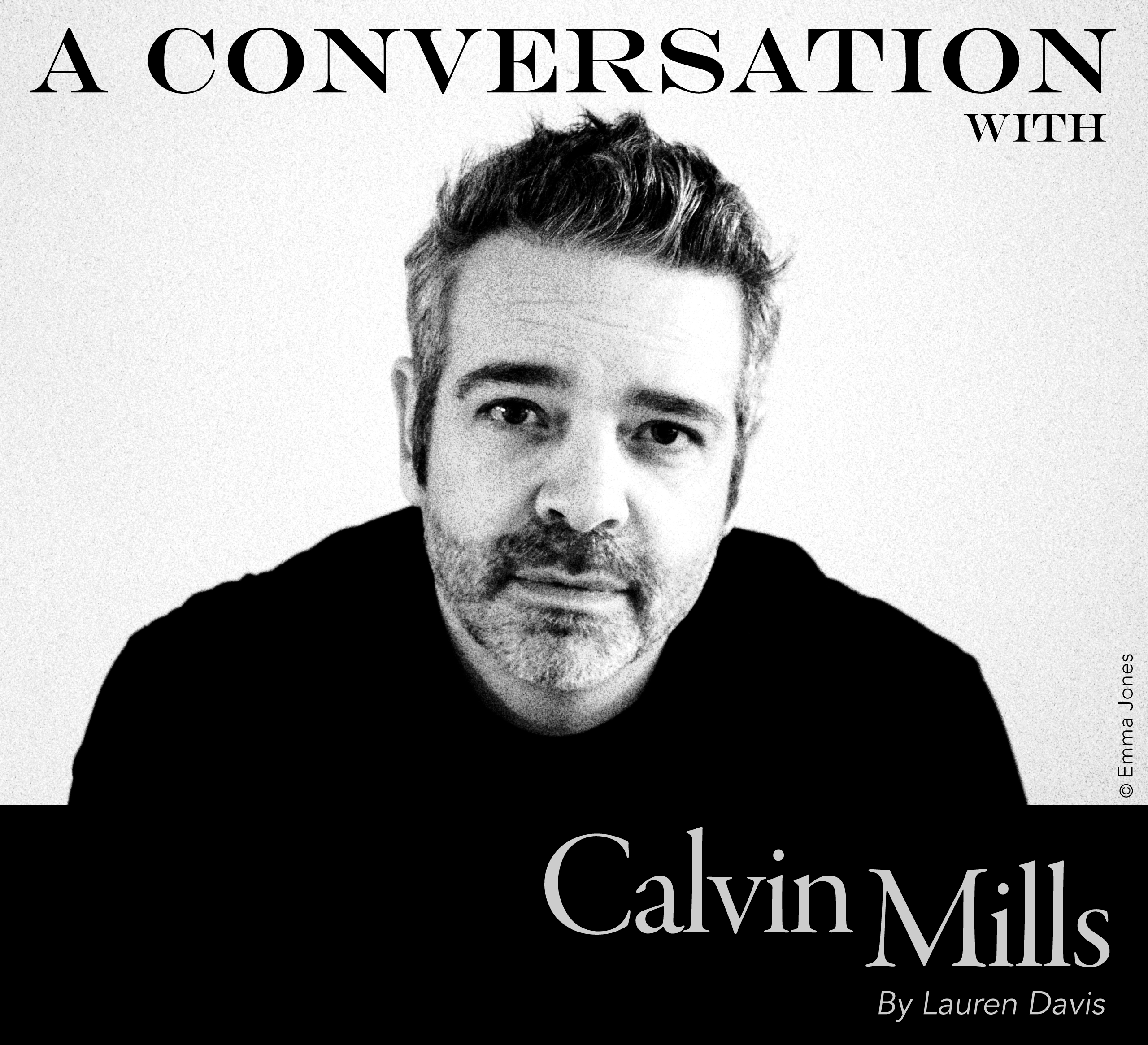
CALVIN MILLS released his surreal debut short story collection The Caged Man just as 2025 came to a close. As author Dustin Reade says, this book is “dark, dreamlike, but never without a deeply human core,” and within these pages, you can find characters whose longings and traumas transform the space around them into something realer than what can be touched. Mills, who lives on the geographically isolated Olympic Peninsula, shows us what it is to be emotionally isolated yet tethered to the places that give one history.
—♦—
Lauren Davis: Congratulations on the release of your short story collection The Caged Man, which was published in December 2025 by Cornerstone Press and was recently named one of six finalists for the National Indie Excellence Awards for Short Story Collections. The author T. C. Boyle said that your stories leave the reader “surprised and gratified in the deepest way.” I couldn’t agree more. You blur the line between what is material and what is illusory, creating a new sense of reality with each story. Could you tell me a little about the genesis of this book, and how you approached the concept of what is “real” during its creation?
Calvin Mills: Thank you, Lauren (and Mr. Boyle) for the kind words. My earliest writing was realistic and often semi-autobiographical. Before long, I began to flirt with psychology to broaden interpretation. “Nikolai’s Plan” was the first story I wrote that shed the skin of literary realism. The strange goings-on in that particular tale could be attributed, not to surrealism, but to the question of psychology. Are the elderly neighbor’s actions driven by a stroke of genius? Or just a regular stroke? The young man puts his life in Nikolai’s hands either way. The story ends without a clear answer to that question.
I continued to write realistic fiction, but I also began to lean into weird elements in other stories. This led to “The Caged Man,” one of my first stories to be picked up by a magazine. After the relatively quick adoption of that story compared to many of my more realistic stories, I wrote “The Stone and Bone Boy,” which, to my shock and glee, was picked up by Weird Tales. Ann VanderMeer was the editor at the time. Her husband, Jeff VanderMeer, invited me to write a little essay on weird fiction for his blog, which has been a fun fact for me, as his career and circle of influence have skyrocketed, particularly in weird fiction.
Before Ann accepted the story, she sent a note to say sorry she’d been sitting on it awhile. She said she was trying to decide whether or not it was a good fit for Weird Tales. At the time, I took her hesitation to mean that just as many of my stories were too weird for first- or second-tier literary magazines, they were, perhaps, too literary for genre magazines.
For decades, this question plagued me as a writer: how to balance my tendencies toward both weird fiction and realism. Even in this collection, despite the unreal aspects of “The Very Small Door,” “Ascension,” and “The Caged Man,” there are straightforward stories like “The Borrowed Dress” and “Eating Coimbra.”
I assumed when I first saw this divide opening in my work that this was going to be a problem. My realistic story “The Letter” was accepted early on by the journal Short Story. I have never felt that I could put that piece in a collection like this. “Violin Dominicana” was realistic and was nominated for a Pushcart Prize. Granted, it’s set in the Dominican Republic, and it’s about a former child prostitute who plays the violin, making it strange enough to fit well with this collection.
About this chasm between the two styles, I sat myself down and said, “You need to focus, or it’ll take you twenty years to write a cohesive collection. On the other hand, in twenty years, you might have three collections: one of creative nonfiction, one of weird fiction, and one of straightforward literary fiction.” The primary distinctions between each pivot on questions of what is and isn’t “real.” And that is, more-or-less, where I find myself today. I was never able to dam the various branches of the river, but now I have multiple manuscripts in the wings. The apologetic personality of my stylistic splintering into realism, weird fiction, and creative nonfiction still exists.
Believe it or not, I’ve published a handful of stories that went beyond the level of weirdness in The Caged Man, by swerving into absurdism and satire. I toyed with including one or two of those with this collection, but decided against it. Overall, the question of levels of reality in my work is significant. However, I’m starting to think that they might be able to share space after all. Perhaps I’ve been too neurotic, tossing up self-imposed barriers where none exist. After all, every short story is different.
LD: Speaking of the concept of reality, can we talk a little bit about what I saw as a common thread throughout most, if not all, of the book, which was loneliness? In particular, I was struck by the character Marta María’s romantic obsession with the corpse in “The Affable Corpse,” and how her social isolation seemed to play into that. I couldn’t help but see parallels between her obsession and AI psychosis, which we, as a society, are just now naming. There’s a timelessness to your characters’ struggles. Was this a theme you set out to write about with intention? Or did it naturally emerge?
CM: I definitely did not set out to write about loneliness, but now I see it clearly in the book. After I put the manuscript together and sent it around for a year or two, then let it rest for another eight years while I focused on raising my boys, it finally struck me. These stories are of individuals who are in close proximity to others, love others, want and need others, even live with others, but are still very much alone. A friend once told me she’d never felt more alone than when she was in a relationship. She wasn’t just seeing the man in question on the weekends. They lived together. That comment shocked and bewildered me at the time. I don’t think it does anymore. I think that loneliness, sometimes, can have very little to do with your proximity to other people.
It also occurs to me that the way writers are taught to handle both third-person and first-person point of view may be partly responsible for the sense of isolation in my work. To avoid point of view shifts, we glorify Hemingway’s third-person limited omniscience, right? In first-person, the voice is direct, the point of view clear, not to be diluted by other perspectives, not even for an instant. The result? All we know is what one character knows, and most of the characters in my book are eventually defeated in their attempts to be close to others. In real life, lovers leave us, parents pass away, friends drift apart, grown children rarely call or visit. These results of love and connection are not surprising. Bleak? Perhaps, but not unrealistic.
Because virtually all literary writing advice gives preference to this limiting sense of perspective, might this be what readers subconsciously want? Are avid readers introverts? Are they lonely? Do they seek like experiences in fiction? I think they are thoughtful people who understand human suffering better than the average person cares to. I also think that much fiction relies heavily on more direct social interaction between characters, whereas my stories lean toward individuals who are in close proximity to others, but still feel alone. I now recognize this sense of isolation in my nonfiction essays, in one of my novels, and in my other story collections, too. The novel I’m trying to finish now is a rare example of the opposite. It is highly “social” in nature, with multiple protagonists in a tight-knit subculture where the sense of community they find is at the forefront thematically.
Considering the question of isolation in The Caged Man and where it comes from, I love the idea of the “secret self” in the book Alone with All That Could Happen: On Writing Fiction by David Jauss. He claims that readers get to know authors intimately, more so than people who know them in real life, because authors reveal secrets, desires, and unpopular opinions through fiction that most people would never admit to. Raymond Carver acknowledged that, as a writer, you have to be willing to tell on yourself. The fact that there is a long line of characters who are, more or less, alone in these stories, probably says something about my personality, experience, and/or psychology. I’ll admit, as a creative person, I spend quite a bit of time in my own head, even when I’m around others. I can’t be the only one who’s worrying about money, or replaying an unpleasant conversation in my head while sitting down to dinner with family, can I? Maybe it’s just me. Or maybe it is artists in general. Donald Woods Winnicott said, “Artists are people driven by the tension between the desire to communicate and the desire to hide.”
As for Marta Maria, talking to the corpse, I see what you mean about her delusional “conversations” reminding you of the way some people communicate with AI because he only tells her what she wants to hear. Today, social media and AI are heavy weights to bear. As for AI, the more I hear about it, the more it troubles me. The other day I lost my temper with Siri when she failed to give me driving directions. “You’re useless, Siri,” I growled. What’s worse? I felt I’d been abusive, because in real life, I would never call a human useless. I had a strong urge to apologize. On occasions when she’s actually helpful, I feel obliged to say, “Thank you, Siri.” I literally have to stop myself. I think that words are powerful, and speaking to computers, or allowing them to think or write for us, is much more serious than most people realize. I’m also sure that few people who use AI understand how often it hallucinates, lies, or is just plain wrong.
LD: You’ve given us some wonderful reading recommendations so far. What were you reading while writing these stories, and how did those other pieces influence your work? Also, in your acknowledgements, you mention “(the memory of) Raymond Carver,” and, of course, his name has already come up. Do you believe he has also been an influence on your style?
CM: Originally drawn to serious reading by the spare prose of Hemingway and Carver, and the less spare novels of Steinbeck and Kerouac, I later found weird fiction wrestling for my heart. It started with Latin American writers: Arenas, Márquez, Borges, Ferré, et cetera, who leaned unapologetically into magical realism or postmodern experimentation. For a long time, this felt indulgent, and I worried writing weird stories myself would make me guilty of cultural appropriation, or worse (and I’m being a little tongue-in-cheek here)—genre fiction.
As for the question of cultural appropriation, in another life, I married into a half-Cuban and half-Colombian family who had lived all around the world on assignments from the United Nations. We regularly traveled to Spanish-speaking countries; we spoke Spanish at home, et cetera. My wife at the time had a PhD in Latin American Literature, so, of course, I was reading widely from Central and South American writers. Literature, writing, language, and travel were huge parts of our lives. But, who was I to write a story from the perspective of someone in another country? In a writing workshop circa 2000, a young woman took issue with one of my stories. She said, “How dare you write a story from a woman’s perspective?” Because of comments like this, there was some uncertainty in the early days about writing so many female characters, too.
As for the question of being guilty of genre fiction, I read and enjoyed every Stephen King short story I could find, but never admitted that at the time. Of course, after a few decades of living in this apologetic headspace, I re-read Kafka’s The Metamorphosis, encountered the rare surreal Bukowski story “Six Inches,” remembered how offbeat Hawthorne and Poe were, and zeroed in on the weirder works of Murakami, Rushdie, Boyle, Brockmeier, Link, and so on down the line. In other words, I was reminded of the universality of weirdness and surreal elements in fiction on the global scale.
I also appreciated the way Stephen King spoke about the literary establishment’s narrow views of genre fiction, and I was entertained by his secretly publishing literary realism before he was ultimately summoned into the fold by the literary establishment, invited to choose stories for literary prizes, et cetera. I also read Bradbury, Atwood, Orwell, Huxley, and Toni Morrison’s Beloved, where as a reader, I was not acutely aware that I was reading sci-fi, speculative fiction, or ghost stories. I only felt that I was reading classic works of literature.
Even when I wrote the micro-essay on weirdness in fiction (including literary fiction) for Jeff VanderMeer’s blog many years ago, I’m not sure I quite believed my own advice. I was clearly torn between two veins in my work: the straightforward realism and the weird. I’m trying now, with this book, anyway, to neither apologize for the real nor the surreal. T.C. Boyle started his blurb for the book by saying, “Stories that make the real surreal and the surreal real,” which I find wonderfully succinct.
Speaking of the surreal, no discussion of my influences would be complete without mention of film director David Lynch. The way he bends reality and refuses to explain himself in favor of the audience owning their own interpretations pleases me greatly. In one interview he said “the film is the thing,” meaning that after the work of writing, an incredible amount of effort is poured into every detail, requiring hundreds of people to devote months or even years to creating this audio-visual work in the language of cinema. Then, the instant the film is released, the press wants you to somehow make it back into a handful of words. I love Lynch for his refusal to talk about certain things. It keeps the viewer’s relationship with the work oddly pure to never hear the director contradict their interpretation of a fundamentally mysterious storyline in, for example, Mulholland Drive or Lost Highway. The world of fiction is similar. When someone realizes you have written a book, the first question you get is, “What’s it about?” Writers struggle with this innocent and kind-hearted question, or when asked to describe their writing style as if one’s style might be boiled down to a sentence or two.
Hemingway’s geographically diverse body of work inspired me, too. I’d never seen an author bounce from Mt. Kilimanjaro to Central Park, from Havana to Paris, from Milan to rural Michigan. The stories in The Caged Man are set in at least half a dozen countries, a detail that worried me in terms of finding a publisher. I blame Hemingway, Kerouac, and Bowles—for both my love of travel and for my tendency to braid travel and fiction.
In terms of southern influences, while living in Arkansas for a dozen years, I found an affinity for the exaggerated and quirky characters in the stories of Flannery O’Connor—who I often refer to as the Quentin Tarantino of American short fiction. I resonated with the first-person voices of Eudora Welty, the structural complexity of Faulkner, and the near-mythical elements of setting in Twain.
As for Raymond Carver, my long connection to him came from a sense of place and of grounding literature in the real world. He had lived in the small town where I grew up. He wrote about Eureka, Arcata, and McKinleyville, California, in his stories. He had been a janitor at the local hospital and attended the local state college. His first wife waited tables. He was the first writer I was able to envision as something less than a celebrity or a ghost. He has guided me in other ways, but not as much in style. Most people would agree that my style is a long way from Carver’s in this book and in all but my most realistic fiction. He loathed irony, for example, which I indulge in. However, I do live by the advice his mentor, John Gardner, gave him about revision and editing. Gardner’s idea of the “fictional dream” is at the core of my editing process. Detailed in his book The Art of Fiction, this writing and editing technique pivots on the idea that well-executed fiction can engender a dream-like state in its reader. Therefore, anything that might break the reader’s trance should be eliminated in revision and editing. Which mistakes might cause fissures in fictional dreams? All of them: a typo, a word choice, an editorializing narrator, questionable character motivation, a lack of concrete sense and detail, a flowery description, even a sentence with one too many words. Taken to the extreme, it argues that the writer should be invisible, the focus razor-sharp on the character’s tactile experience. To nurture such a trance, the writer questions everything, treats every sentence, every action, every word choice as potentially dream-shattering.
I also owe Raymond Carver and Tess Gallagher gratitude because hosting the Raymond Carver Podcast allowed me to sit down with a handful of very serious writers. Their tenacity, focus, and enthusiasm for writing drove me to get serious about my own submissions again.
LD: With regard to place, you also teach writing at Peninsula College in Port Angeles, Washington, the same city where Raymond Carver is buried. What advice do you have for writers who want to challenge genre expectations and invite the weird into their writing and sense of place?
CM: I was hyperaware, as my sons started school, that I could thoughtfully approach the idea of being “weird” and what it meant to them—in case anyone ever made them feel weird in a bad way. I tried hard to make weird a good word in our house. I called myself weird, called them weird (in kind tones). “If anyone ever calls you weird,” I said, “tell them, ‘Thank you!’”
Port Angeles is as weird as any place. It feels a bit like the television show Twin Peaks sometimes. You might get the sense that you’ve stepped back in time here, as far back as the 1950s. There are other strange things: shoes with feet inside wash up on beaches with alarming frequency. Every year people disappear in the national park. Angry men bulldoze neighbors’ houses. Sonic booms materialize from invisible origins. We have the legend of the Lady of the Lake, whose corpse turned to soap. People come here looking for Bigfoot. There are spiritual and magical elements of stories here much older than any European inhabitant, too. The local tribes, who have lived on this land since time immemorial, have rich and active traditions where songs and stories are still foundational to knowledge and culture and to understanding one’s place in the world. If none of those examples strike certain students, it sometimes helps to point out weird details in biblical stories, or “weird news” items like the fact that scientists have already created human-pig hybrids.
In terms of genre or style expectations, another writer I studied with in the South, David Koon, once said, “Don’t worry who will or won’t publish any given story. Just write it. Good work will find an audience.” I like that advice. Though it should be noted, actually finding that audience is still a challenge when your work walks a tightrope between literary and weird fiction.
LD: I love that advice, too. By the way, it has always seemed to me that the finest short stories, in general, tend to utilize endings very differently than novels do, often by leaving questions unanswered. When writing these pieces, how did you know when you had found the endings?
CM: To be honest, I rarely do. My endings are often retooled more than once. I am a terrible judge of my own writing, endings in particular. At least twice, while finishing stories, typing the last line has brought me to tears. The image, the syntax, the resonance all rang true in those moments. As the lines of text blurred through my upwelling emotion, I sincerely believed those stories would be among my very best. The funny thing is, two decades later, neither of the stories I’m thinking of has been published after dozens of submissions, while others have been picked up on the first, fifth, or tenth try.
I can openly declare that the ending is usually the part I tinker with most. I don’t think that’s uncommon. I know from my friendship with Tess Gallagher that when she and Ray Carver worked on each other’s stories, they spent quite a bit of time on two things: shedding the false motions, and looking for just the right line and image to end on.
I think literary fiction has the capacity to contain both surprise and a sense of the inevitable. As a reader, the end of a good short story might very well catch you by surprise, just before—upon closer inspection—resonating backward through every other detail to leave you thinking that the story could not have properly ended in any other way.
LD: There’s a sentence in “The Very Small Door” that reads, “I needed to suffer.” What role, if any, do you think short stories play in helping the reader understand their own relationship to morality, guilt, and suffering?
CM: As for morality and guilt, I don’t think readers want predictability or morality tales. I can say that the term “moral relativity,” when I first encountered it, gave me profound food for thought. When we assume that other people, even our closest friends or lovers, are guided by the exact same moral compass, unpleasant surprises are likely. Humans excel at justifying bad behavior. In fiction, that’s just fine. Overly moral creatures can be predictable and dull. In stories, we appreciate characters who make mistakes or take risks. In real life, we generally avoid unpredictable people.
When it comes to suffering, I tell my students three basic things about literature. One, writing, like dancing, film, painting, any of the arts really, is ultimately about one person reaching out to others, seeking connectivity. Two, writing is based on conflict, which relates directly to suffering. Three, when it comes to education, where are we going to learn about human suffering in the intimate, familial sense, if not in the arts? We don’t study divorce, adultery, or bankruptcy (unless you are talking about Sunday School, in which case we are back to talking about morality tales). Chekhov’s story of adultery in “The Lady with the Dog” is very different from one you’d be told in Sunday School. We don’t study a cancer diagnosis, the loss of a child, or the suicide of a lover in history, math, or biology class. But we will, can, and should experience these things in stories. They teach us about the most fundamental aspects of human suffering—not those motivated by history or politics, but those we invite, simply by living, through the risk of loving others. In literature, we find these forms of suffering as open as the pages of a well-worn hardcover with a cracked spine. Witnessing fictional suffering is valuable because, when we inevitably encounter the unthinkable ourselves, we remember (or we can find) the stories of others who have suffered the same losses, which, bringing this conversation back to your second question, can help us feel less alone.
Meanwhile, as introverted as we may be, we should never write off the value of connection. Having one person you can count on can make all the difference in the world. I still believe that suffering is best diminished by love. ■

Calvin Mills hosts the Raymond Carver Podcast. He is the author of The Caged Man (Stories), from Cornerstone Press (2025) (a NIEA finalist) & A Handful of Tragic Days, a chapbook of creative nonfiction essays (2025) (Winner: Eggtooth All Genre Chapbook Prize). His work has appeared in Short Story, Weird Tales, The Brussels Review, The Quarter(ly), and Short Form Creative Writing: A Writer’s Guide and Anthology. His writing awards include a Meritorious Achievement Award from the Kennedy Center American College Theatre Festival as a playwright. He teaches writing at Peninsula College in Port Angeles, Washington.
Learn more at https://calvinmillslit.com
—♦—
Lauren Davis is the author of The Nothing (YesYes Books), Home Beneath the Church, and When I Drowned. Her writing has been a finalist for the Ruth Stone Poetry Prize and the Press 53 Award for Short Fiction, among others. She holds an MFA from the Bennington College Writing Seminars. https://laurendavisauthor.com
© 2026 Small Print Magazine. All rights reserved.
No portion of this article may be copied, reproduced, distributed, transmitted, stored in a retrieval system, published, or otherwise used without the prior written permission of the copyright holder, except as permitted by law.
The copyright holder expressly reserves all rights concerning the use of this work in connection with artificial intelligence and machine-learning technologies. This work may not be used, whether in whole or in part, for the training, development, fine-tuning, evaluation, testing, or improvement of any artificial intelligence system, large language model (LLM), machine-learning model, generative AI system, or similar technology without the prior written permission of the copyright holder.